Translate

Showing posts with label tradition. Show all posts

Saturday, 15 August 2015

What is Obon?


Hello! This is going to be a lighter than usual entry, but still has it's interest spark ;P

So 2 days ago my teacher told me that there was a traditional celebration going on in Japan called Obon (お盆). Then he proceeded to show me an interesting video about it which I'll link down below. 
After that he explained that it is a time when roads are full because everyone drives back to their hometown. He used to see this celebration back at home but added that is not traditionally celebrated that much anymore. This means that people rather go to the popular congregations where there's music playing and a matsuri (festival) in general rather than doing the purification at home and spending time at the cemetery (I guess). He also said that his parents don't celebrate it anymore but his grandparents do (so 30 years ago). He remembers going up to the cemetery as a young boy and when leaving they would "pretend" to carry their ancestors on their backs to their homes, spend some days with them at home (honoring them, serving them food) and then they drop them back to the cemetery the same way they took them until the next year.


The Obon holiday (also known as Ullambana Festival or Ancestor Day (Buddhist) festival  which has evolved into a family reunion holiday) was created in Japan to honor one’s deceased ancestors. Often, people will return to their ancestors graves to visit and clean. This celebration has been going on for over 500 years to date.  The festivities include a dance, known as “Bon-odori.” This festival lasts for 3 days, but starts on a different date in each region of Japan, so every region has its own way of doing it. 


It is a customary belief that the ancestors’ spirits visit the world of the living during Obon. Lanterns are hung in front of the houses to guide the spirits; Obon dances (or Bon Odori) are performed to welcome the spirits and to appreciate the ancestors’ sacrifices; people visit the ancestors’ graves; and food offerings, as well as prayers, are offered at the altars and temples. 

As Obon occurs in the heat of the summer, participants traditionally wear yukata, or light cotton kimonos. Many Obon celebrations include a huge carnival with rides, games, and summer festival food like watermelon.


Bon Odori

Bon Odori is a traditional dance that originates from the story of Maha Maudgalyayana (Mokuren), a disciple of Buddha, who used his supernatural powers to look upon his deceased mother. He discovered that she had fallen into the Realm of Hungry Ghosts and was suffering. Greatly disturbed, he went to Buddha and asked how he could release his mother from this realm. Buddha instructed him to make offerings to the many Buddhist monks who had just completed their summer retreat, on the fifteenth day of the seventh month (although it would be July we are talking from the perspective of the lunar calendar, so it's August). The disciple did this and, thus, saw his mother's release. He also began to see the true nature of her past selflessness and the many sacrifices that she had made for him. The disciple, happy because of his mother's release and grateful for his mother's kindness, danced with joy. From this dance of joy comes Bon Odori or "Bon Dance", a time in which ancestors and their sacrifices are remembered and appreciated.

You can get an idea of the dance with this video :


In this next video the music is live and you can hear the taiko (Japanese drums) very well:


Depending on Japan’s region, Obon is observed from the 13th to the 15th day of July or August. The last day of the festival is ended with floating lanterns (or Toro Nagashi). Paper lanterns are illuminated and then floated down to rivers, lakes, and seas in order  to guide the spirits’ return to the other world. Fireworks display usually follows. 


That's all for this, did you know this festivity? Today it's its last day "officially"!

Sources: source1 source2


Wednesday, 22 July 2015

Tales of the world (II)


Today I'm coming to you about another story about the stars! (ehehehe), this one is an Australian one.


The seven sisters

Once upon a time there were seven very pretty hunter sisters. They were called Meamei and they all had long black hair and bright bodies due to the icicles they had on their skin. They were like a gulp of icy water in the hot country they lived.

They never joined any other groups while hunting: in spite of this, there was a family of brothers called Berai-Berai, who admired the beauty of the sisters and wanted to marry them. The Berai-Berai were honey hunter experts and they would often leave sweet beehives outside the Meamei's campsite.
The lovely girls would eat, giggling, but didn't even want to hear about their admirers when they talked about marriage.

Nevertheless, they had an even more dangerous wooer. Wurrunnah, the Scorching Ancestor, who set up a trap and captured them. But even for him, the seven strong hunters were too difficult to control, so he took five and deposited them on the sky. He kept two, and he tried to melt their icicles, but the only thing he accomplished was to put out their own fire.

After fighting with all their might, the two sisters escaped the claws of Murrunnah and reunited with the others on the sky. But if you look at the Pleiades, which is in what the Meamei turned, you'll see that there are two of them who don't shine as bright as the others do. They are the two sisters whose light was attenuated by Wurrunah's embrace.

The Berai-Berai were bereaved at the loss of the precious Meamei and didn't even want to consider the possibility of marrying any other girls. They didn't want to eat, and little by little they would languish while contemplating the seven stars. After their death, the spirits took pity on them and now you can also see the boys up in the sky. On the north they are known as the belt and the sword of Orion, but the Australian aboriginals call them Berai-Berai.

The Berai-Berai still go hunt honey among the stars and the Meamei sing nocturnal songs for them from their campsite. When it is cold, some break little pieces of ice from their bodies and throw them at the Earth. When the aboriginals see the frost in the morning they know that the Meamei haven't forgotten about them. And when there's thunder, they say that the Meamei jump in the water, while they play betting who makes the most noise when falling. Then they know that the rain is coming.


The end.

Behind the story


Image credit: Marco Lorenzi


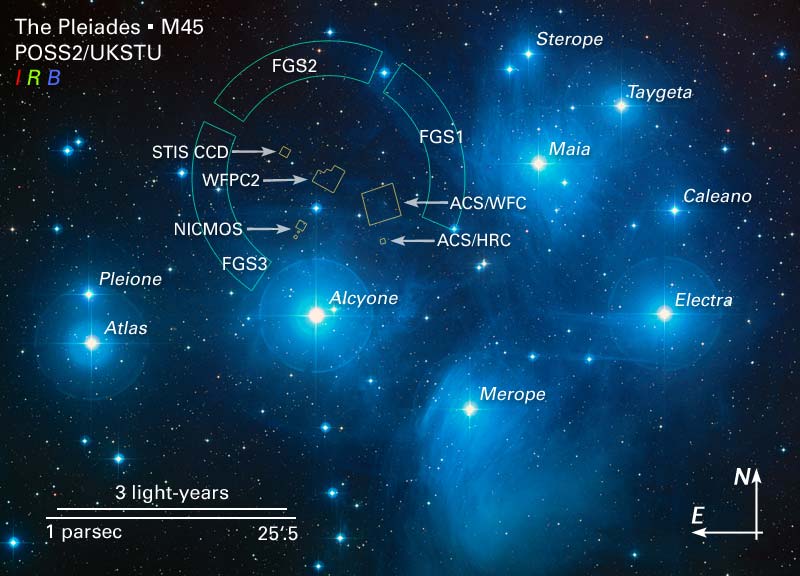
Perhaps the most famous star cluster on the sky, the Pleiades are one of the clusters that make up the constellation Taurus and can be seen without binoculars from even the depths of a light-polluted city. Also known as the Seven Sisters and M45, the Pleiades is one of the brightest and closest open clusters. The Pleiades contains over 3000 stars, is about 400 light years away, and only 13 light years across. Quite evident in the above photograph are the blue reflection nebulae that surround the brighter cluster stars. Low mass, faint, brown dwarfs have also been found in the Pleiades.


The Pleiades are a prominent sight in winter in the Northern Hemisphere, and have been known since antiquity to cultures all around the world, including the Celts, Māori, Aboriginal Australians, the Persians, the Arabs (known as Thurayya), the Chinese, the Japanese, the Maya, the Aztec, the Sioux and Cherokee. 

This celestial entity has several meanings in different cultures and traditions. There are so many points of view! Which come to show how different we all are. Here are some:

  • In Hinduism, the Pleiades are known as Krittika and are associated with the war-god Kartikeya (also known as Murugan or Skanda), who derives his name from them. The god is raised by the six Krittika sisters, also known as the Matrikas.
Lost Pleiad (1884) by William-Adolphe Bouguereau.

  • In Greek mythology, The Pleiades, companions of Artemis (sister of Apollo, goddess of hunting, always accompanied with a deer, a bow and some arrows), were the seven daughters of the titan Atlas  (the primordial Titan who held up the sky. He is also the titan of astronomy and navigation) and the sea-nymph Pleione. The Pleiades were nymphs in the train of Artemis, and together with the seven Hyades were called the Atlantides, Dodonides, or Nysiades, nursemaids and teachers to the infant Bacchus (the god of theatre, wine and ritual madness). 
Their story goes as this:After Atlas was forced to carry the heavens on his shoulders,Orionbegan to pursue all of the Pleiades, and Zeus transformed them first into doves, and then into stars to comfort their father. The constellation of Orion is said to still pursue them across the night sky.


  • In Japan, the Pleiades are known as 昴 Subaru which means "coming together" or cluster in Japanese, and have given their name to the car manufacturer whose logo incorporates six stars to represent the five companies that merged into one.

This is the logo

  • A Cheyenne myth "The Girl Who Married a Dog", states that the group of seven stars known as the Pleiades originated from seven puppies which a Cheyenne chief's daughter gave birth to after mysteriously being visited by a dog in human form to whom she vowed "Wherever you go, I go".

  • A Cherokee myth indicates that seven boys who would not do their ceremonial chores and wanted only to play, ran around and around the ceremonial ball court in a circle, and rose up into the sky. Only six of the boys made it to the sky; the seventh was caught by his mother and fell to the ground with such force that he sank into the ground. A pine tree grew over his resting place.

  • In Thailand the Pleiades are known as Dao Luk Kai or the "Chick Stars", from a Thai folk tale. The story tells that a poor elderly couple who lived in a forest had raised a family of chickens: a mother hen and her six (or alternately seven) chicks. One day a monk arrived at the couple's home during his Dhutanga journey. Worried that they had no suitable food to offer him, the elderly couple contemplated cooking the mother hen. The hen overheard the conversation, and rushed back to the coop to say farewell to her children. She told them to take care of themselves, and that her death would repay the kindness of the elderly couple, who had taken care of all of them for so long. As the mother hen's feathers were being burned over a fire, the chicks threw themselves into fire in order to die along with their mother. The deity, impressed by and in remembrance of their love, immortalized the seven chickens as the stars of the Pleiades. In tellings of the story in which there were only six chicks, the mother is included, but often includes only the seven chicks.

  • Surprisingly, on a similar note, to the Vikings (Norse mythology), the Pleiades were Freyja's (a goddess) hens, and their name in many old European languages compares them to a hen with chicks.


Curiosity! A bronze disk, 1600 BC, from Nebra, Germany, is one of the oldest known representations of the cosmos. The Pleiades are top right!


The name

The name of the Pleiades comes from Ancient Greek. It probably derives from plein ('to sail') because of the cluster's importance in delimiting the sailing season in the Mediterranean Sea. However, the name was later mythologised as the name of seven divine sisters, whose name was imagined to derive from that of their mother Pleione, effectively meaning 'daughters of Pleione'. However, in reality the name of the star-cluster almost certainly came first, and Pleione was invented to explain it.
The Pleiades (1885) by the Symbolist painter Elihu Vedder

A map of the Pleiades


It's curious how everyone interprets things their own different or similar way, right? We all see things differently and that's so enriching as long as we don't put others down just for having other ideas, it's awesome.

That's it for today, not sure what else to say!


See you,


B.


Monday, 13 July 2015

Tales around the world (I: Tanabata)

Visiting other worlds


***Listening to: Mad Summer - Joe Hisaishi (I recommend the whole playlist I linked though!)*** 


Greetings! 

In this section I'll tell you about tales from different cultures as I love discovering them myself. I am no expert, but I hope you enjoy it anyway.

This story has to do with something that took place last week, and I've unconsciously knew about it since I was a child. As someone obsessed with the spheres I collected books on the matter from a young age. This (and many others haha) was one of the stories I used to read before bed back in the time. I wouldn't completely make sense out of it but it was still cool to me.

Without further ado, *ikuzo!

*Japanese for let's go!


My childhood book containing the story


The lovers who were apart

Tentei, the king of the stars, had a very beautiful daughter, whose name was Orihime. Princess Orihime was a great weaver and created the most wonderful pieces. His father was proud of her but he kept her so busy that she never had time for anything else. Orihime was sad because she thought she would never find someone to fall in love with.

Finally, her father felt sorry for her and chose her a husband. Kengyu was a cowherder that lived at the other side of the river. Orihime and Kengyu married each other and were ecstatic, so much so, that Orihime forgot about her weaving and left it to dust and didn't make another piece at all.

Tentei was angry, as he believed Orihime abandoned her job. Consequently, he decided to separate both lovers and make them live on one side of the river each. But this was no common river (that wouldn't have been a big deal, huh?), because, in fact, this was the river that crossed the realm of the stars. We are talking about the Milky Way. This way, there's no way Orihime and Kengyu can cross it.

Orihime missed Kengyu so much she cried until her tears started dripping and fell to the dress she was wearing. "You'll stain your dress!" Tentei said. "Okay, if you miss your dear so much I'll allow you to see him once a year". 

That's how the king of the stars arranged it so that once per year, on the seventh day of the seventh moon, the waterman of the Moon crosses the vast river to take Orihime to the other shore in order to meet Kengyu.

Regardless, if the princess doesn't weave as she is meant to, Tentei makes it rain so hard that the river overflows and the waterman cannot get to her. When this happens, all the magpies of Japan gather and fly to the river on the sky, making a bridge so that Orihime can walk softly over the feathers of their backs so she can finally reach Kengyu.

And there's nothing his father can do to prevent that.


The end.


The story today

The threads of this little story are still attached to Japan's culture, and to this day it is kept as a tradition. The seventh day of the seventh moon (interpreting the lunar calendar that would be the seventh month, July) there's a *matsuri (*Japanese for "festival") all over the country: its name is Tanabata (this means "evening of the seventh").

Tanabata, also referred to as Star Festival, as with many aspects of Japanese culture, has its origin in Chinese culture. The festival was imported by an Empress in 755 (Heian period), and was initially adopted in the, back then, capital of the land of the rising sun: Kyoto. When it was first recognized in Japan, Tanabata was celebrated only by imperial court officials. It was considered a graceful event, full of the simple elegance so associated with the Heian era of Japan. Lanterns were lighted, and poems were written on mulberry leaves still holding their dew (Nojiri, 1973).

Traditionally, it was an event held in order to "plead for skills". It spread to the majority of the population, therefore, it wasn't the same in every region. However, in general, girls wished for better sewing and craftmanship, and boys wished for better calligraphy skills by writing on strips of paper.

Despite that, these days not the same is done. Like other Japanese matsuri, many outdoor activities are going on that add to the festive atmosphere: you will find many stalls selling food (usually there are typical sets of food selling in the festivals which deserve their own blog entry, but something made for this occasion are Tanabata somen or somen noodles, which are cold noodles with various toppings), providing carnival games, selling bits and bobs (like masks), etc. Today, people (especially children) are more prone to write any kind of wish (quoting my *sensei or Japanese for teacher, for example, something like: I wanna be a Doraemon! :D) on *tanzaku (Japanese for "small piece of paper"), and hang them on a tree or bamboo.

At the end of the night or the day after, they often release the bamboo shoots along with the tanzaku in the river as a cleansing ritual.

Hasimoto Hanano 橋本花乃Tanabata 七夕 - Japan - ca.1930


On my research I also have found this interesting information:

"It is interesting that in some regions of Japan, Tanabata is accompanied by a taboo forbidding swimming or bathing in a river. Noting the relation with the celestial "river" or milky way, the taboo is based on the idea that a Kappa or water deity resides in the river, and one should not make the pure water dirty by entering the water deity's home."

To finish with, there's a reason why rain is pretty significant in the story: rainy season. In most of Japan it takes place from the beginning of June to mid July. Taking other regions into account, Okinawa (southern Japan) gets it one month earlier, and Hokkaido (northern Japan) barely gets affected by it.


A street decorated for Tanabata.
These jellyfish like decorations are streamers that symbolize the weaving done by Orihime.


Behind the story
All these moving images are from this photographer here

And to finish with, and just for curiosity and for the sake of knowledge, we are going to take a look at the names, bits of language, which are very self-explanatory but make one understand the story better just by knowing them and nothing else.


-Orihime--------> Weaving Princess (note that the suffix -hime, used after someone's name, always means princess. In conclusion, -hime is the Japanese for "princess". Example: Skyhime, would mean princess of the sky).
Behind Orihime is the star Vega, which is meant to be her representation, and can be seen around that time of the year.

-Kengyu also, and maybe more well-known as Hikoboshi--------> Cowherder star. I referred to him as Kengyu because this is how "I got to know him". In my book he was called Kengyu what can I say, call him how you like it best :).
The star called Altair is meant to represent him, and is also seen in the night sky those days.


-Tentei---------> it means Sky King or king of the universe itself. In an equivalent way, in Chinese tradition he is Yu Huang or Yu Di (we know him as the Jade Emperor). He is meant to be the first God and he appears in other traditional stories and legends.

-Ama no gawa-------> Ama no gawa is a word I really like. Literally, it means "heavenly river". If you think about it for a second you will realize that the river in heaven is that one composed by stars that we call Milky Way (although to me Via Láctea or Via Làctia sound much prettier than the English and German counterpart; romanic languages reunite!! hahaha). This word is beautiful.

(Okay wait a minute haha, I just noticed that here I am, unfairly comparing a word I know from the languages I learn for no clear reason and deciding which one sounds prettier for the sake of visual and audio aesthetics so I can build a personal "Only pretty words from every language" dictionary. I'll let you know when it's finished okay? Let's all speak the most aesthetically pleasing way possible xD).


Hope you found this informative as well as interesting!


See you soon,


Bertahime :P


PS: Sorry for mixing languages x) Those who know me know that I can't get my mind straight and in oral speech I tend to mix languages otherwise I literally translate them because at that precise moment I don't know the equivalent and it sounds profoundly weird (see: "al final del dia" said to try and mean "at the end of the day" x) ).


References:

http://www2.gol.com/users/stever/orihime.htm

https://en.wikipedia.org/wiki/Tanabata